
- You are here:
-
Home

- Training
TIPS Training Workshops (9)
For information about the TIPS Training courses and to register, contact Rozale Sewduth rozale@tips.org.za
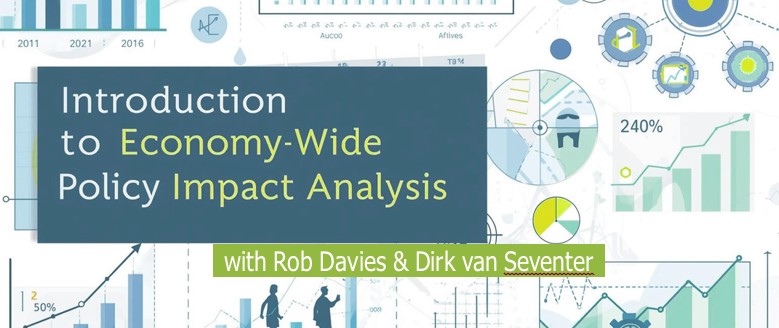
13 - 16 April 2026 - TIPS Office: 234 Lange Street, Nieuw Muckleneuk, PTA
Price: R16 000 vat included (per delegate) and $1000 ( for delegates from developed countries)
Acceptance deadline: 3 April 2026
The economy is a system. Disturbances to one part, which might be caused by policies or by unanticipated shocks, can have consequences for other parts. Responses to these knock-on effects may create feed backs, enhancing or constraining the initial impact. Understanding these system wide effects can be important for policy design, since they determine how the costs and benefits of a policy are distributed throughout the economy.
Most graduates of economics programmes have in their toolbox microeconomic methods, for analysing the behaviour of individual agents and markets, and macroeconomic methods, for analysing the economy as a whole. These are powerful tools, but the latter do not give the detailed view of the economy that policy analysts often want, while the usual ceteris paribus assumption of microeconomics can often be inappropriate when the shocks are large.
Input-output and Computable General Equilibrium (CGE) models provide tools to examine the economy as a whole while also incorporating sufficient detail to address impacts on sectors and income distribution. Wassily Leontief published his first input-output paper in 1936. Leif Johansen published his pioneering CGE model in 1960. However, although there was substantial work developing both these approaches in the decades before 1990, they both remained rather niche approaches until the rise of cheap computing power and modern data.
Since 2000 there has been an explosion in the literature using these tools, extending the range of their application. The methods, either by themselves or in conjunction with models from other disciplines, are being brought to bear on a wide and expanding range of issues of concern to the modern world: climate change, renewable energy, AI, water scarcity, regional integration, trade in value added, value chains, the causes and consequences of macroeconomic fluctuations.
Approach
The workshop will introduce participants to the databases on which economywide models are based: supply and use tables, input-output tables and social accounting matrices. It will then cover the fundamental methods of multiplier analysis and illustrate how they can be extended to a range of issues. The teaching method focuses on hands-on practical application. All models are implemented in Microsoft Excel.
Upon completion, participants will possess both the theoretical foundation and practical expertise necessary for linear economy-wide impact analysis. The workshop also offers valuable preparation for process managers required to interpret such analyses, and provides essential groundwork for those wishing to pursue computable general equilibrium (CGE) modelling.
A subsequent CGE modelling workshop will be available for interested participants.
Course facilitators
Rob Davies is a Zimbabwean economist who lives in Harare. He previously served as Chair of the Department of Economics at the University of Zimbabwe. His academic career includes roles as a visiting professor at Swarthmore University in the United States, a visiting senior lecturer at SOAS in the United Kingdom, and a visiting research fellow at the Human Science Research Council (HSRC) in Pretoria, South Africa. He is a director of the Trade Law Centre (tralac), a public benefit organisation based in Cape Town. He has published extensively and collaborated with organisations such as the World Bank, South African National Treasury, TIPS, UNU-WIDER, Global Trade Analysis Project, and the International Food Policy Research Institute. His recent work uses Computable General Equilibrium models to address policy issues such as automation, labour market polarisation, carbon taxes, electricity shortages in South Africa, climate change in Zimbabwe, the green economy in Vietnam, and COVID impacts.
Dirk van Seventer is a New Zealand-based applied economist specialising in macroeconomics, trade and labour market economics, multisector input-output and Computable General Equilibrium modelling. After completing his Masters in Economics at the Rijksuniversiteit van Groningen in the Netherlands, he moved to South Africa where he worked as economic researcher at the University of Stellenbosch during the 1980s, the Development Bank of Southern Africa during the early 1990s and TIPS in the late 1990s. In early 2000 he followed his family to New Zealand where he worked at the Department of Labour for six years as a Principal Information Analyst. Currently, Dirk is an associate economist with the consulting firm Infometrics in Wellington, New Zealand and a modelling expert with Genesis Analytics Consulting in Johannesburg. He has published widely in South African and international journals. and has contributed to building numerous Social Accounting Matrices for several countries in Southern Africa and Asia.
For more information contact Rozale Sewduth at Rozale@tips.org.za
We are bombarded daily with messages about technological disruption, including the advances in AI and automation that lie ahead for workplaces, workers and infrastructure. It is often hard to decipher the implications for our work, key industries, and society. At the same time, indicators of South Africa’s innovation performance and longer-term technological capabilities show a concerning downward trend. But we don’t need the statistics to tell us what we can see when we visit companies or workplaces. In almost every sector, a handful of companies are thriving by being innovative. In contrast, a large group of companies appear to lag technology and innovation trends. In many sector strategies and industry action plans, technology is treated generically. The result is that those who can, innovate; and those who can’t, fall further behind.
This course will focus on the factors that shape our industries' ability to learn about new technology and the ecosystem that supports innovators. It will help participants to discern the noise from the signal and equip them to help industries or other stakeholders better observe, anticipate and strategically respond to technological change opportunities.
Course Faciltator: Dr Shawn Cunningham, project leader of the Technological Change and Innovation System Observatory implemented by TIPS.
Date: 17 & 18 February 2026
Venue: TIPS Office: 234 Lange Street Nieuw Muckleneuk Pretoria
Cost: R7000 (Including VAT) per delegate
For more information contact Rozale Sewduth at Rozale@tips.org.za
For more information on the TIPS Technological Change and Innovation System Observatory visit: https://www.tips.org.za/projects/technological-change-and-innovation-system-observatory
For more information on the training workshop download the brochure.
The function of this workshop is to build industrial research, strategy and policy capabilities in South Africa to better understand the dynamics of value chains and in so doing, to contribute to employment growth and productivity enhancement through upgrading.
Date: 20 & 21 November 2024
Venue: TIPS Office: 234 Lange Street Nieuw Muckleneuk Pretoria
Cost: R7000 (Including VAT) per delegate
For more information contact Rozale Sewduth at Rozale@tips.org.za
- Download brochure (2348 Downloads)
This course will focus on the factors that shape our industries' ability to learn about new technology and the ecosystem that supports innovators. It will help participants to discern the noise from the signal and equip them to help industries or other stakeholders better observe, anticipate and strategically respond to technological change opportunities.
FACILITATOR: Dr Shawn Cunningham
DATE: 28 - 29 August 2024
COST: R7000 (VAT included) per delegate
For more information contact Rozale Sewduth atRozale@tips.org.za
Download the brochure below
- Tech Change Innovation System training workshop 2024 - Brochure .pdf (2028 Downloads)
This workshop focuses on the question of what does a developmental macroeconomic policy regime look like? It is aimed at senior government officials working on industrial and other economic policies. The aim is to open a broader, more inclusive and more informed debate on macroeconomic policy in South Africa. It will draw on the momentum created by post-crisis discussions of macroeconomic policy and the critiques of the policy status quo.
FACILITATOR: Seeraj Mohamed
DATE: 3- 4 October 2024
COST: R7 000 (VAT included) per delegate
For more information contact Rozale Sewduth at Rozale@tips.org.za
Download the brochure below
- Macroeconomics training workshop 2024- Brochure.pdf (1602 Downloads)
The function of this workshop is to build industrial research, strategy and policy capabilities in South Africa to better understand the dynamics of value chains and in so doing, to contribute to employment growth and productivity enhancement through upgrading.
FACILITATOR: Prof Justin Barnes
DATE: 9 - 10 July 2024
COST: R7 000 (VAT Inclusive) per delegate.
For more information contact Rozale Sewduth at Rozale@tips.org.za
Download the brochure below.
- Value Chains training workshop 2024 - Brochure (the dtic).pdf (1110 Downloads)
The course will provide participants with insights into how the world trading systems work and South Africa’s trade relationship with key regions.
FACILITATOR: Faizel Ismail
DATE: 23-25 October 2024
COST: R12 000 (VAT Inclusive) per delegate
For more information contact Rozale Sewduth at Rozale@tips.org.za
Download the brochure below.
- Trade Policy Mod 3 training workshop 2024 - Brochure.pdf (976 Downloads)
The workshop aims to provide students with new and deep insights into an actual trade negotiation that will facilitate a discussion on:
❖ The role of power relations between players in trade negotiations and how this power is used in the process of the negotiations;
❖ An overview of the changing global trade architecture and South Africa’s relations with key bilateral trading partners;
❖ How ideas/language/narratives/research are used to advance particular interests and negotiating objectives of the dominant players; and
❖ Alternative approaches to trade negotiations and outcomes that are more equitable and development-oriented
FACILITATOR: Prof Faizel Ismail
DATE: 14-16 August 2024
COST: R12 000 (Vat included) per participant.
For more information contact Rozale Sewduth at Rozale@tips.org.za
Download the brochure below
- Trade Policy Mod 2 training workshop 2024- Brochure.pdf (1038 Downloads)